
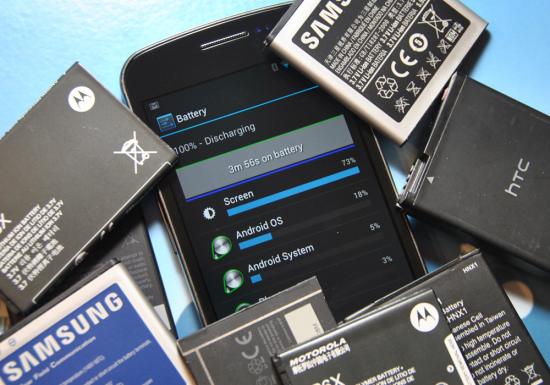
Smartphone has become all the rage these days.. They are now capable of replacing so many gadgets we used to have, say 15 years ago. They are the pioneers of the market for portable electronics. They are now more of a necessity than a luxury, as cheaper and yet capable phones like the Moto G have flooded the market. Everyone wants one and most have one (or two, or three?). Smartphones have evolved over the years and almost all the aspects of the phone has improved manifolds. Like, we now have 1080p display as a norm, a quad core CPU with a few GBs of RAM is a very common combination. Some also feature 21MP cameras with 4K capability. In the radio department, we now have 4G capable devices with multiband WiFi. While all aspects have evolved over the years, there is one aspect, however, that remained untouched. Its the very thing that keeps our device ticking (at Gigahertz speed…), and you guessed it, its the battery!
Although we have moved from the Ni-MH (Nickel-Metal Hydride) batteries to Li-Ion (Lithium Ion) cells, but that happened before the smartphone era. Ni-MH batteries had quite a few drawbacks that made them unsuitable for use with portable electronics. To name a few, they were heavier, had low energy density, low charge and discharge rate, low shelf life/standby time, and the infamous memory effect. The newer Li-ion tech was leaps and bounds better than Ni-MH tech, but in the earlier days, they used to be quite expensive, and this is what kept it out consumer’s reach… As manufacturing techniques evolved, the way they always do, they became more and more feasible for use in daily electronics. Today, they completely replaced Ni-MH from the consumer tech scene. But before we go ahead with the review and teardown of a Powerbank, let’s first get to know a bit more about the battery technology and how to take care it.
A Li-Ion cell, in simple terms, is a rolled up sandwich of four thin films floating in an electrolyte solution
- Anode
- Separator
- Cathode
- Separator
This one here is a cylindrical one. The flat ones rolled into a slab instead of a cylinder. The separator is there to stop movement of the electrolyte but allow passage of the Li-ions. That’s more chemistry than you probably need.
Next, lets go and kill some myths…


2 Comments
Subhomoy Das
26 June, 2014Hi. Just wanted to know what will happen after the charging discharging cycles mentioned are passed??? Shall i have to throw it away?
Sunit Nandi
26 June, 2014After the rated charging-discharging cycles, the product may or may not function the way it is. The battery may no longer hold charge or energy like it used to.